.webp?width=1280&name=untitleddesign(38).webp)
One of the most important decisions you have to make while downsizing your company is the remaining furniture that you have to leave behind before moving to your new home. This guide navigates how to efficiently organise your furniture, divided by different categories and common scenarios of how to deal with your furniture in long-term and short-term periods.
Key Takeaways
Sort every piece of furniture into one of four categories before you touch a moving truck: Keep & Use, Store Short-Term, Store Long-Term, or Dispose & Donate. That single decision pass determines everything else — how many trucks you need, how much storage, and how long it takes.
A 5-person office can usually finish this sort in an afternoon. A 200-desk floor decommission needs a coordinator and a multi-day plan. If your downsizing project only runs 6-8 weeks, look for storage terms with no lock-in contract — booking a 12-month unit for a 2-month gap wastes money.
The 4-Category Sorting Framework: Understanding What to Keep or Donate
Every piece of office furniture falls into one of four categories, and deciding which one early stops items from being underused, which could be a waste of resources, especially when you are downsizing your companies. With a comprehensive and thoughtful coordination, a sorting task could take one or two staff in a few hours, to a few weeks with larger enterprises.
- Keep & Use: these types of furniture are going straight into the new, smaller space. Ask yourself if this desk or chair will still be used in the next 12 months, and does it fit a hybrid or hot-desking layout. Minimalist, modular pieces that can be reconfigured into task-based zones usually make the cut; oversized executive desks built for a single fixed layout often don't.
- Resell: These items are longer fit with the new floor plan or layout, which you should resell. Usually, valuable resells are in good condition, solid-wood furniture or oversized executive desks that couldn’t be reconfigured.
- Store Long-Term or Short-time: These items are what you'll need again once the new fitout is complete, typically within 3-6 months. As for archival furniture, seasonal stock, or unnecessary items that might be associated with personal values and experience, long-term storage might be a great idea.
- Dispose & Donate: anything that won't be reused could be donated or disposed of, from clean, like-new furniture, duplicate items to extra pieces, smaller accent furniture.
Tips: For hardwired furniture, such as built-in reception desks or workstations wired for power and data, contact a trusted electrician to disconnect and safely remove them before deciding to dispose of them.

Sorting Timeline for a Downsizing Office
Once you have planned your company move, set aside approximately one to three months to prepare for sorting your furnishings according to the four categories listed above. The table below shows a detailed list of actions in accordance with a specific time frame when you enter the preparation phase of a moving plan.
|
Timing |
Action |
|
6-8 weeks out |
Run the 4-category sort across every zone |
|
5-6 weeks out |
Confirm disposal/donation pickups for anything not being kept |
|
4 weeks out |
Book disassembly and storage (confirm short-term vs. long-term split) |
|
2 weeks out |
Photograph and label items scheduled for disassembly |
|
1 week out |
Confirm landlord move-out condition requirements and any certificate of insurance needed for building access |
Staged Storage — What Nobody Tells You About the "In-Between" Period
Downsizing rarely happens in one clean move. Most businesses go through an interim period, typically from three to six months where the new, smaller office is being fitted out while the old furniture sits somewhere else. The problem: you don't yet know exactly what will fit until the new floor plan is finalised.
This is where a rigid 12-month storage contract works against you. If the fit-out takes 8 weeks, you shouldn't be paying for a year. With mobile storage models like Super Easy Storage, the no lock-in contract terms mean you can book storage for the actual project window and extend only if the timeline slips, no penalty for finishing early, you pay for the period you use.
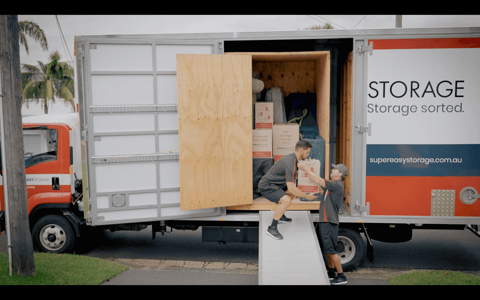
If your filing cabinets, spare desks and archive boxes are all on one pallet, retrieving a single cabinet mid-project shouldn't mean unpacking everything else. A mobile, door-to-door storage model where the unit comes to your site solves this problem, and being able to track the truck online means you're not guessing when a retrieval or drop-off will actually arrive.
.webp?width=1440&height=1566&name=untitleddesign(38).webp)
Estimating How Much Storage Space You Actually Need: Things to Do After Sorting
If you are thinking of storing your belongings, there is no one-size-fit-all format to estimate how much storage unit you need. As a rough starting point, a standard workstation, chair and two filing cabinets, disassembled, take up meaningfully less space than the same items stored whole, which is one reason disassembly matters even for the space-planning stage.
Rather than estimating by eye, the storage calculator tool gives a size and cost estimate based on actual item counts, removing the guesswork that "just get a storage unit" advice leaves you with.
The right storage type also depends on scale. A handful of desks and cabinets from a small team fits comfortably into standard 10m3 storage unit of Super Easy Storage A full floor decommission with dozens of workstations, archive volumes and shared equipment is better suited to warehouse-based self-storage or business & commercial storage, which is built for higher volume and longer-term business assets.
Efficient Storage with No Lock-in Contract with Super Easy Storage
Life changes, and sometimes moving to an office takes more time than you might expect. Booking a moving service offering comprehensive solutions, ranging from furniture dismantling and interstate transport to storage can help you save time effectively.
Super Easy Storage covers both ends of that gap: mobile storage delivered to the current office, and self-storage for anything that needs to sit in a warehouse until the new site is ready — with no lock-in contract tying the booking to a date that might still shift. With professional removalists accompanying each moving plan, save yourself from tons of errands and let Super Easy Storage’s team take care of your preparation to continue with your moving plan.
FAQs for Further Tips to Sort Your Items Effectively
1. Can I store office furniture short-term without a 12-month contract?
Yes. No lock-in contract terms mean you can book storage for the length of your actual project, commonly 6-8 weeks for a downsizing fit-out rather than being forced into a 12-month minimum.
2. What happens to furniture that can't be reused, like old filing cabinets or partitions?
If it fails to reuse or resell, it goes to disposal or donation. Usable furniture in reasonable condition can typically be donated; damaged or obsolete items go to recycling. Old electronics and IT equipment attached to furniture (monitor arms, powered desks) usually need e-waste disposal separately from general furniture disposal.
3. Do I need professional movers to disassemble modular desks and workstation pods?
For standard flat-pack desks and pods, professional disassembly and reassembly reduces handling and damage risk compared to staff doing it without the right tools. On the other hand, glued furniture that needs professional handling, or hardwired furniture, consider calling a professional team, either an electrician to disconnect or removalists team to dismantle before it can be moved, regardless of who handles the rest.